
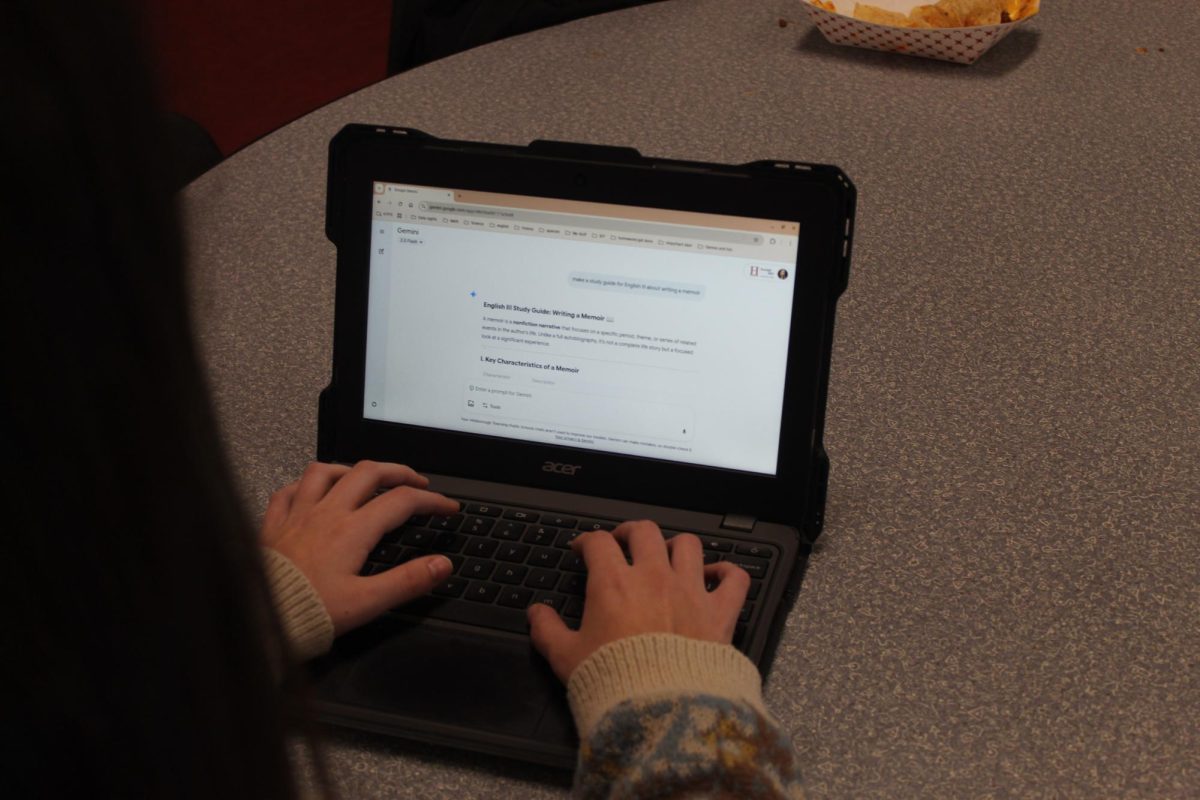
With the 2025-26 school year kicking off, there have been teachers that are finding ways to use AI in a positive way, mainly in English classes. Teachers even let their students use AI as a helpful tool during school hours. “We actually give students suggestions of ways that they can use AI. Some ways we’ve suggested they use it are study guides. They’re able to create practice tests and vocab quizzes,” Mrs. Nicole Rokoszak said. In the classroom, students and staff members, like Rokoszak, have noticed the AI usage rate going up, because teachers are allowing their students to use it when necessary. Instead of swapping essays with classmates, students open a new tab with Google Gemini AI. Within seconds, suggestions and feedback appear. Artificial Intelligence is slowly finding its place in classrooms, not to replace traditional learning techniques, but to help students think, edit and express their ideas in a better way.
Many teachers have started introducing AI as part of their lesson plans rather than avoiding it. In some classrooms, students use AI to brainstorm essay topics, summarize lengthy readings, or for generating practice questions before a test. What used to be seen as “cheating” is now being called “smart studying,” as long as students use it responsibly. Teachers, though, are still trying to figure out where to draw the line. Some see Gemini as a good learning tool, but other teachers worry that it would take away the student’s creativity and originality, said Mrs. McCabe, one of our vice principals.
Teachers like English teacher Mrs. Kimberly LaHart share that they like using Gemini. “I think Gemini has been really helpful, for sure,” said LaHart.
Teachers like LaHart see AI as an extension of the students learning habits. Instead of replacing their creativity, it gives them a space to refine their ideas. Senior, Sia Shah mentioned that English subject teachers are encouraging students to use AI tools as a “second reader” to check for clarity, grammar and structure while reviewing their college essays. “I think AI is both helpful and really destructive. It helps a lot with schoolwork and research because it saves time by compiling all the websites and gives you everything in one spot,” said Shah.
“It can be helpful in a school environment, to provide information for various sources across the web when it cannot be easily found just through a search engine,” sophomore Josephine Pfeiffer said.
Vice Principal McCabe shared that AI is being introduced as a research and learning tool, but not a tool to cheat from, she explained that when AI is used appropriately, AI can help students save time by summarizing information and gathering sources. McCabe also noted that the school has formed an AI committee to guide this process, “The committee is made up of myself, Mr.DiLollo and several teachers,” said McCabe.
Across different subjects, from science labs to history projects, AI is becoming a quiet partner in the learning process. Students use it to review complex concepts, generate explanations and practice tests. Instead of taking away their effort, many say it actually encourages them to understand the material better. One of these students includes senior Rachel Paul Johnson. “It’s effective because it helps me summarize my notes. Or if there are any other concepts that I don’t understand, I plug in the video or note and ask for a summary of something I don’t get,” Johnson said.
As AI is more commonly used in the school, students are starting to learn that how they use it matters. According to many, AI tools are effective when provided with the right prompts like asking for help creating a study guide or practice tests.
According to the Hillsborough High School’s academic integrity policy, AI tools such as ChatGPT may be used for learning and research when permitted by a teacher, but all final work must reflect the student’s own work and submitting AI generated content as original work is considered a violation of academic honesty expectations.