
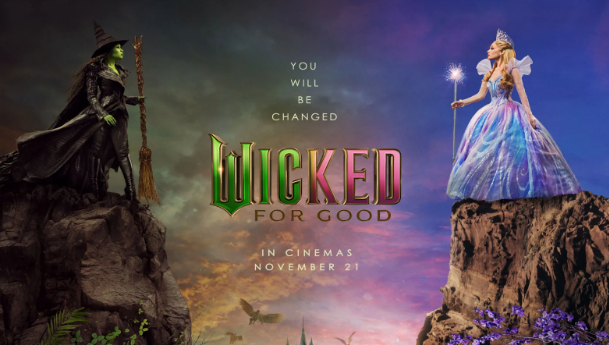
“Every Day More Wicked,” is the first track of the newly released movie sequel, “Wicked: For Good,” and it seems that the title is more than fitting. Every day, more and more fans have begun to mourn the end of the “Wicked” movie franchise, which was first released in 2024.
The finale of the “Wicked” broadway show turned movie series, “Wicked: For Good,” premiered on Nov. 21 featuring Cynthia Erivo as Elphaba Thropp, the Wicked Witch of the West, and Ariana Grande as Glinda Upland, the Good Witch. The film, directed by Jon M. Chu, is a continuation of the first “Wicked” movie adaptation, which aired Nov. 22 of last year, and explored how the two witches met and developed a flawed friendship at the fictional Shiz University in Oz.
The successor, “Wicked: For Good,” takes place beyond Shiz, in the Emerald City. Glinda, now renowned as the “good witch,” and Elphaba as the “wicked,” they are pinned against each other by the public, despite their blooming friendship which is developed throughout the first film. The main point of contention for both the girl’s friendship and Elphaba’s “wickedness,” is her green skin. But despite how poorly she is treated by the people of Oz, she continues to fight until she’s blue in the face and Oz’s “wonderful” wizard is exposed as an animal-abusing fraud.
Off-screen, Erivo and Grande prove to be amazing vocalists, and that’s still true of them when they’re in character. Perhaps that’s why the songs, in both the first and second film, are outstanding. The movies’ composer, Stephen Schwartz, is partly responsible for that as well. As for the vocals, the wicked and good witch star in most selections, with the most memorable songs being, “No Good Deed” with Erivo and “Thank Goodness / I Couldn’t Be Happier” with Grande. Both songs, while vastly different in singing style and tone, perfectly embody their characters. Elphaba’s boldness is encapsulated in Erivo’s belts, and Glinda’s bubbly, and artificial, persona in Grande’s high notes and vibratos.
Fans of songs from the first film, or even those who stumbled upon them during “Wicked’s” extensive campaigning, will be glad to hear that they reappear in this new movie. During tracks such as “Wonderful,” there are excerpts from the highly regarded, “Defying Gravity” within it. Here, the song is quoted and re-sung nearly word for word. Yet, in other pieces, such as “Every Day More Wicked,” there are hints of “What is This Feeling?,” with identical instrumentals and varying lyrics. Being able to follow along with these new songs, because they borrow from the previous ones, creates a sense of familiarity and comfort. Artistically, it draws parallels between both films, and in most cases, demonstrates how the characters have evolved. Truly, it gave the film depth beyond its surface-level “enemies-to-friends” plotline.
Since its release last month, I have gone to see the “Wicked” sequel twice. Both times, I left the theatre belting “No Good Deed,” and straining my vocal chords while attempting to sing “For Good,” the final song of the 2 hour and 18 minute long movie. My reason for the re-watch was simply the artistry of the entire film. The use of lighting and wardrobe to contrast Elphaba and Glinda. The scenic nature found in Oz. The ornate building and character designs. There was simply too much to notice, and one mere watch isn’t enough time to do so.
Now while I’m an avid “Wicked” fan, I do have one critique. For those unaware, the “Wicked” storyline is based off of “The Wizard of Oz,” a 1939 film. It follows the story of protagonist Dorothy who is lost in Oz, and to get back home, must follow a yellow-brick road to meet the wizard. Along the way, she encounters a cowardly lion, heartless tin man, and brainless scarecrow who too need help. Glinda Upland and Elphaba Thropp make an appearance here, but they aren’t the focus of the story as they are in “Wicked.” In this movie, they are simply assistants to Dorothy — side characters, if you will. In “Wicked”, the opposite is true, with Dorothy hardly being mentioned. In total, she averaged around 5 minutes of screen time, with nothing but her iconic blue plaid ruffle dress and pigtails being shown. This, reportedly, was done out of respect for Judy Garland, the original Dorothy, who was allegedly abused on set of the film. This gesture was honorable, but I feel its execution was faulty. While Dorothy was supposed to be hidden, there could have been more mention of her interactions with the wicked witch and her rag-tag group of companions. I understand, in theory, that the focus of the film was the two witches; but Dorothy’s inclusion was lazy, and could have been done in a way that better explained the witches’ behavior in the story’s original plotline. What was done exceptionally well, however, was the story of how all of the characters — tin-man, lion, and scarecrow — became the way they did.
“Wicked: For Good,” marked the end of the “Wicked,” movie series, but it was also the continuation of the franchise’s legacy. Glinda and Elphaba will no longer be just Broadway characters, nor two actresses on screen. They will be two witches known for changing everyone’s perception of the world, and the colors green and pink, for good.