

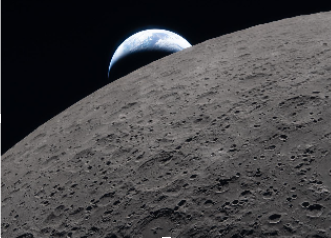
Artemis II was a test flight to learn whether the future Artemis missions would succeed. The entire Artemis program, created by NASA, aims to put humans back on the moon using the Orion capsule. The mission this April also made history with their entire crew. Victor Glover is the first person of color, Christina Koch the first woman, Jeremy Hansen the first non-US citizen, and Reid Wiseman the oldest person to leave Earth’s low orbit. They’ve also set the record for the farthest distance from Earth a human has ever gone at 252,756 miles or 406,771 kilometers, breaking Apollo 13’s record. The crew gained global attention, which lead to the emergence of the term “Moon joy.” The Artemis II’s mission goal was to confirm Orion’s systems, crew operations and procedures before the more extensive lunar explorations could take place within the next decade. Its missions paralleled Apollo 8’s in 1968 and the trajectory of Apollo 13 in 1970.
It takes a lot for the rocket to even lift from the ground. NASA officials have to make calculations that are so exact they may have to redo them based off of a single slight change to the environment or weather or their findings during tests. Mr. John Askew, a teacher in the science department and the advisor for the STEM Club, explained the process. “Rockets leave the Earth’s atmosphere by going really fast. The immense speeds needed to leave the Earth’s gravity are achieved by burning fuel and expelling the super-hot fuel particles out of the thrusters. The law of conservation of momentum propels the rocket upwards (the opposite direction of the expelled fuel). The rocket continues burning fuel, getting faster as it gets lighter (from the fuel loss) and travels higher. Many rocket systems feature multiple stages of thrusters furthering this acceleration by burning more fuel and eventually shedding the mass of the booster once expending the fuel. The trick from there is to curve the path of the rocket so it ascends into an orbit around the Earth, rather than just flying out into space.”
In a future mission scheduled for 2027, Artemis III will make another crewed launch into Earth’s low orbit, testing out connections between the spacecraft and one or both commercial landers from SpaceX and Blue Origin. Artemis IV is scheduled for early 2028 and will consist of a crewed lunar landing. The mission will aim to explore the South Pole of the Moon. The crew will take back samples and be able to analyze them, bringing in new information about the Moon and our solar system. Artemis V will be the last of the Artemis missions as of now, and will also be a lunar surface mission. It will be scheduled to launch in late 2028, with missions every year after the initial one. Artemis V is also the mission in which NASA is expected to start their construction on a lunar base.
Mr. Askew elaborates on his excitement of future space exploration. “I am a big fan of space exploration. There is a lot out there in the universe and we’re just getting started with exploring our own “backyard.” I’m most excited about the discoveries that will be made with further exploration both for our understanding of the universe and for the new technology that will be developed in the process,” Askew said.